
Your Baby's Senses
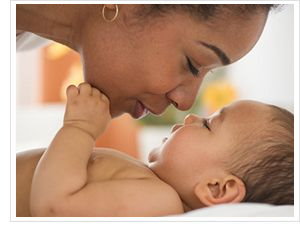
During the first 12 months, your baby grows from being aware only of herself to being able to appreciate and enjoy her surroundings. Her five senses also develop rapidly.
Hearing:
At birth your baby will recognize his mother's voice - and possibly his father's. He will be startled by loud noises. By 3 months he'll respond to familiar voices even if he can't see the person speaking. By 6 months he'll recognize the vowel sounds, tone, pitch and lilt of his native language.
Sight:
At birth your baby can focus on objects 15-20 cm (6-8 in) away. At this age, the retina's rods (cells responsible for detecting black and white) are more developed than its cones (cells responsible for detecting color). Between 2 and 4 months your baby's vision improves a great deal, enabling her to follow moving objects and look towards sounds. She can also distinguish color, as her retinal cones have been activated. By 5 months she can judge how far away things are. At 8 months the number of synapses in the visual cortex of her brain peaks.
Taste:
Your baby can tell many different flavors from the moment he is born, but he will only be interested in sweet and umami tastes initially, which help to relax him, as they are the component tastes of breast milk. Sour tastes will cause your newborn baby to purse his lips, while bitter tastes will upset him. Although he can taste salt, he neither likes nor dislikes it, and will not show a reaction.
Smell:
Your newborn can discriminate between many different smells: infants as young as 6 days old have been shown to recognize their mother's breast odor. However, your baby cannot tell if an odor is good or bad, even through the first year of life. This ability does not develop until three years of age.
Touch:
Your baby's sense of touch develops from the top down, with the strongest sense of touch in her mouth - one of the reasons that babies explore new objects by putting them in their mouth. At birth, your baby's tongue is her primary means of distinguishing shape and texture. When using her hands, it is not until 10 weeks that she can identify shapes, and 6 months that she can distinguish texture.